Stephan has been creating his own choreographic work since the mid-1990s, with two pieces supported by the Portuguese Ministry of Culture. Media were part of his work from the start: joseph b. (1996) and its development mais calor no jardim BL2-27…azul (1997) made extensive use of video, and Sync. (2004) used live video on stage. This line of work led to the digital performance .txt, awarded the Portuguese National Multimedia Prize (2010), and to I-CARE-US (2014).
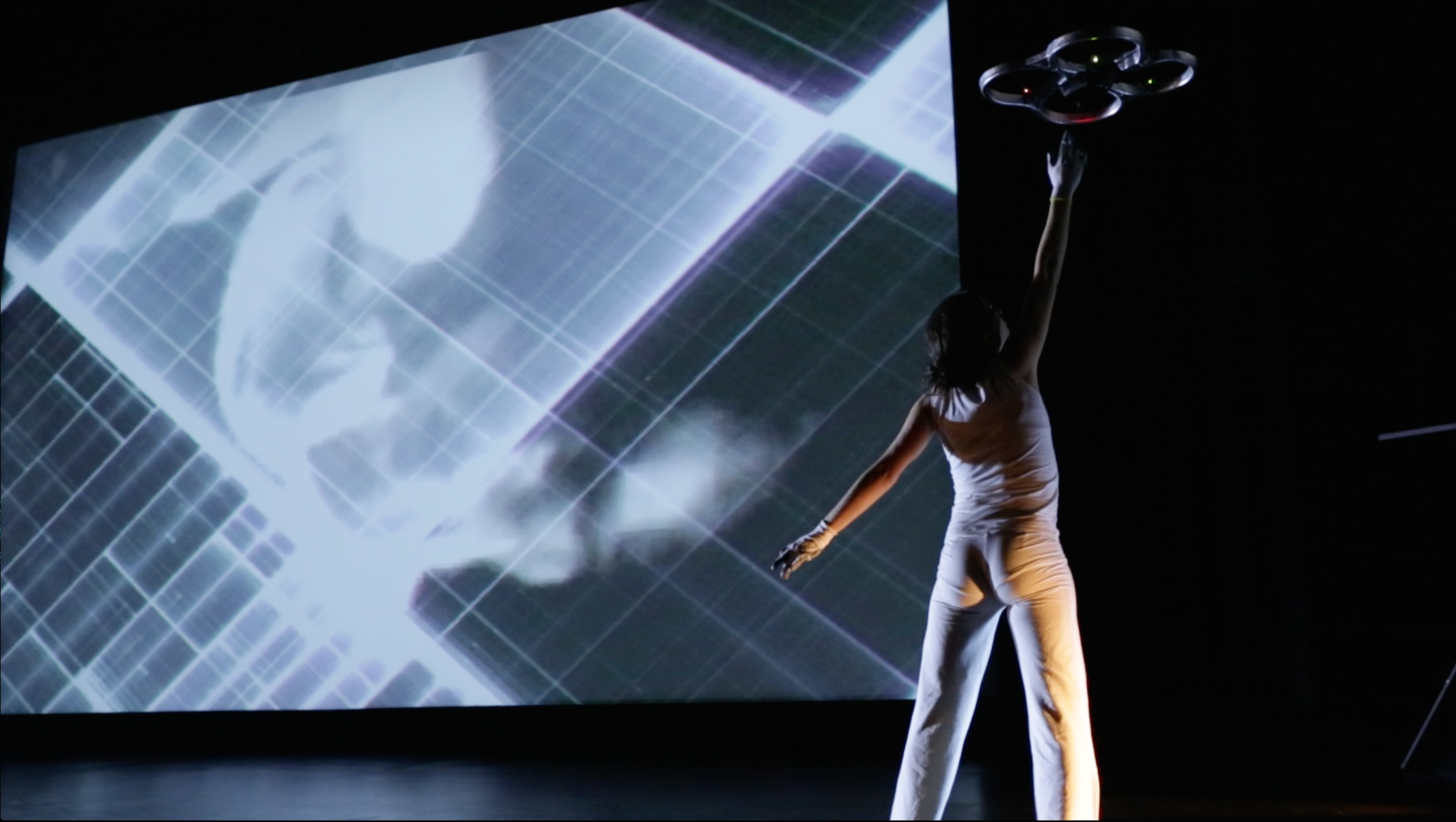
I-CARE-US (2014)
I-CARE-US (2014)
Digital performance for dancers and flying robots, by Fernando Nabais and Stephan Jürgens
Festival MONSTRA, Lisbon, March 2014
I-CARE-US is a digital live performance in which re-programmed quadrotor drones (Parrot AR.Drone 2.0) engage in an "inter-species" dialogue with human performers. A custom stand-alone application, developed in LabView, used sensor data and live video streams from the drones to design (semi-)autonomous, social interaction behaviours, rather than simple flight control. The project was a milestone in Stephan's work: from here on he used the term "transmedia choreography" for the application of choreographic principles across media, reflected in his article "Transmedia Choreography: Integrating Multimodal Video Annotation in the Creative Process of a Social Robotics Performance Piece" (Body, Space & Technology, 2014).
Credits: artistic direction Fernando Nabais and Stephan Jürgens; programming Sandro Fioravanti; interactive sound design Simão Costa; lighting design Miguel Cruz; dancers Miguel Santos, Marina Nabais and Pedro Ramos; acrobatics coach and guest dancer Diana Niepce.
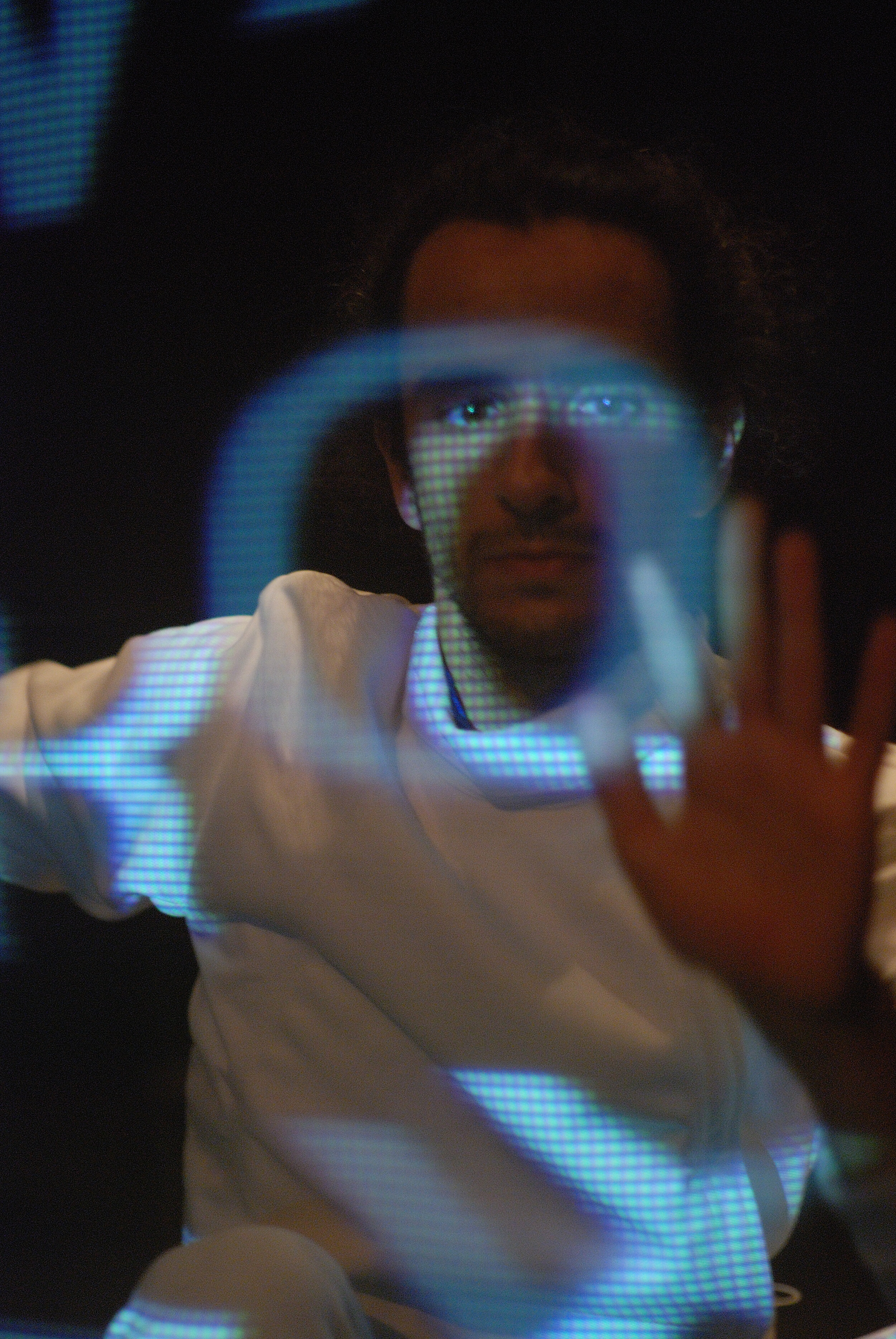
.txt (2006–2010)
.txt (2006–2010)
Interactive digital performance by Fernando Nabais, Stephan Jürgens, Fernando Galrito and Pedro Ramos
ExperimentaDesign Biennial, Museu do Oriente, Lisbon, 2009; tour to Brazil and France
.txt is an interactive performance mediated by sensor technologies, in which a physical vocabulary is articulated through interactive soundscapes, visual composition and real-time choreography. Words are mapped to particle systems whose behaviours follow the dramaturgy, from being discovered, to nervous flocking, to replacing the performer's body, and finally orbiting around him in coexistence. After a beta version in 2008, the piece opened at the ExperimentaDesign Biennial 2009. It received the Portuguese National Multimedia Prize (2010, Art and Culture). Its creative process, including the HCI strategies behind its programming, is analysed in Stephan's PhD dissertation (Chapter 4).
Credits: concept and sound design Fernando Nabais; choreography and video design Stephan Jürgens; visual dramaturgy Fernando Galrito; performer Pedro Ramos; creative software development André Almeida, Gonçalo Lopes and João Frazão; production Sandra Carneiro.
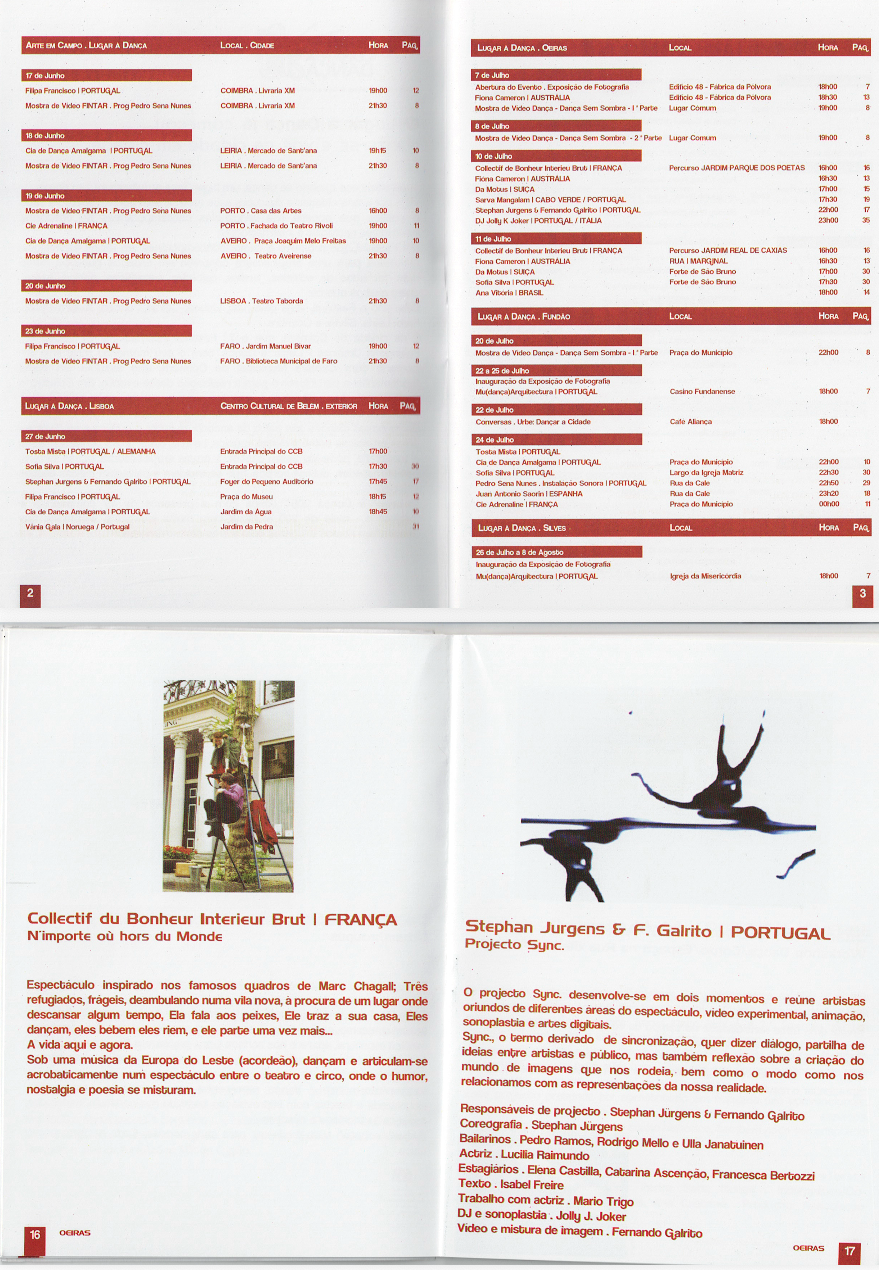
Sync., programme of the 7th Lugar à Dança festival (2004).
Sync. (2004)
Dance, video and digital arts project by Stephan Jürgens and Fernando Galrito
7th Lugar à Dança – International Festival of Dance in Urban Landscapes: Centro Cultural de Belém, Lisbon, and Jardim Parque dos Poetas, Oeiras; also presented in Coimbra and Carcavelos
Sync. brought together artists from performance, experimental video, animation, sound design and digital arts in a project developed in two stages. Derived from "synchronisation", its title points to dialogue and the sharing of ideas between artists and audience, and to a reflection on the world of images that surrounds us and on how we relate to representations of our reality. Performed in public spaces, the piece combined live dance with real-time video mixing on stage.
Credits: project Stephan Jürgens and Fernando Galrito; choreography Stephan Jürgens; dancers Pedro Ramos, Rodrigo Mello and Ulla Janatuinen; actress Lucília Raimundo; text Isabel Freire; work with the actress Mário Trigo; DJ and sound design Jolly J. Joker; video and live image mixing Fernando Galrito. Production Pro Dança, Fernando Galrito and Festival Lugar à Dança.
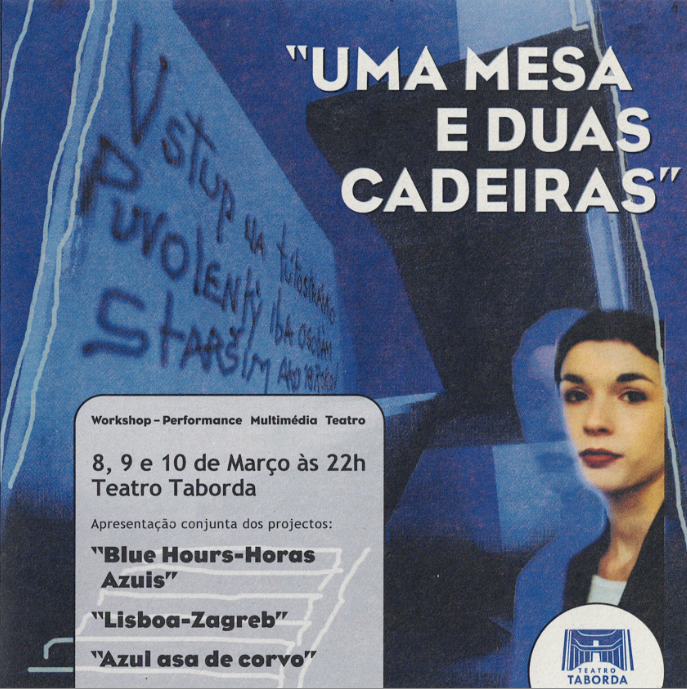
Programme cover, Uma Mesa e Duas Cadeiras, Teatro Taborda (2001)
Blue Hours – Horas Azuis (2001)
Dance, live drawing and multimedia performance by Stephan Jürgens and Fernando Galrito
Teatro Taborda, Lisbon, 8–10 March 2001 – Uma Mesa e Duas Cadeiras
Created for Uma Mesa e Duas Cadeiras, an experimental programme of the Assembleia Geral de Programadores presented simultaneously in several Lisbon venues, Blue Hours brought together on stage a dancer and a comic artist who was also a storyteller. Video cameras captured, from different perspectives, the dancer and drawings made live on paper; mixed on computer, these abstract drawn spaces turned into concrete places where the stories unfolded. The "blue hours" are the forgotten, transitional moments of the city's day, from sunset to the hour before dawn. The piece integrated new technologies while avoiding the dominant discourse of technological promise.
Credits: artistic concept Stephan Jürgens (choreography and performance) and Fernando Galrito (audiovisuals and multimedia); live drawing and animation Ana Carina; DJ Jolly "K" Joker. Production Teatro Taborda / EBAHL; support Assembleia Geral de Programadores.
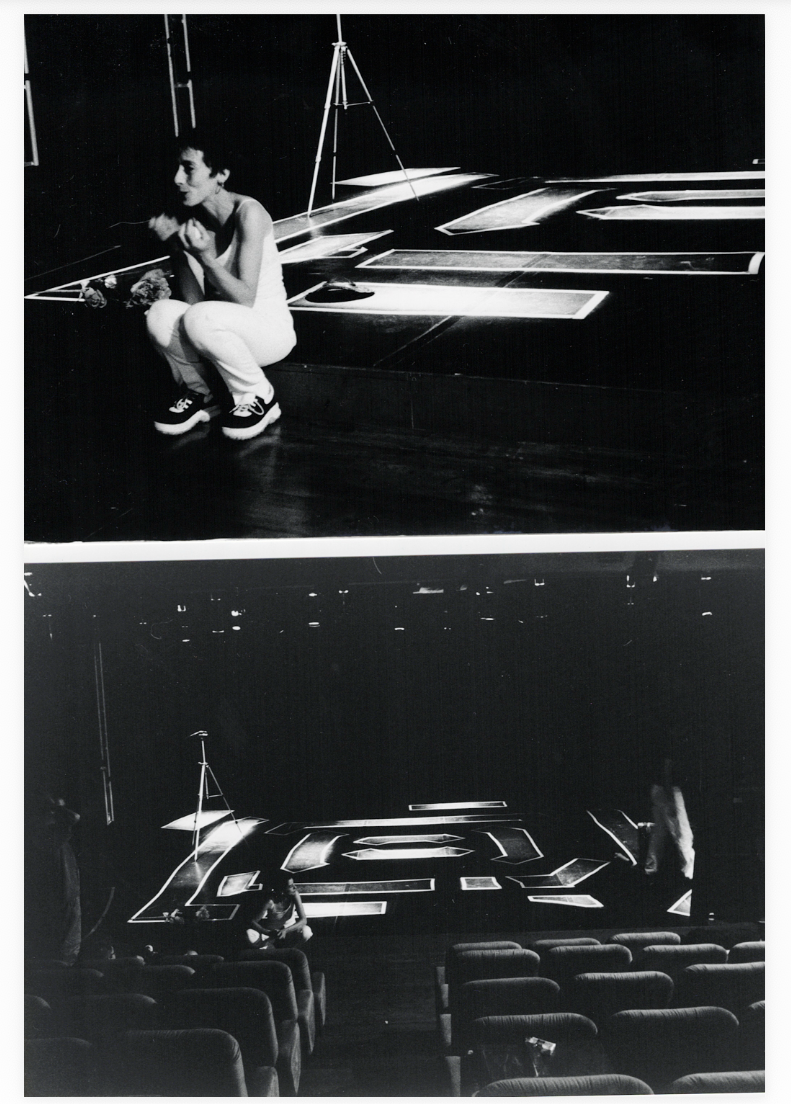
Mentiras (1998)
Mentiras (1998)
Multimedia dance piece by Stephan Jürgens
4th Festival X, Estúdio Latino, Porto, 31 July – 1 August 1998
Based on the Greek myth of the Minotaur, Mentiras was conceived in two parts: a labyrinth installation in the theatre foyer, which audiences had to cross to reach the auditorium, and a stage piece in which two performers used text, dance and video to pursue their physical and virtual relationships like a game of chess. The piece reflected on the search for meaning in virtual lives, from internet chat rooms to interactive media, and on the freedoms and ethical questions raised by creating fictional identities online. The project was supported by the Portuguese Ministry of Culture, which recognised its cultural interest.
Credits: text and choreography Stephan Jürgens; dramaturgy Miguel Clara Vasconcelos; staging Sandra Faleiro; performance Maria João Luís and Stephan Jürgens; original music Claire Honigsbaum; video Marcos Filipe; set design David Vieira and Mário Pires Cordeiro; lighting Pedro Domingos; costumes Filipe Faísca. Production OLHO and Maria Luisa Carles.
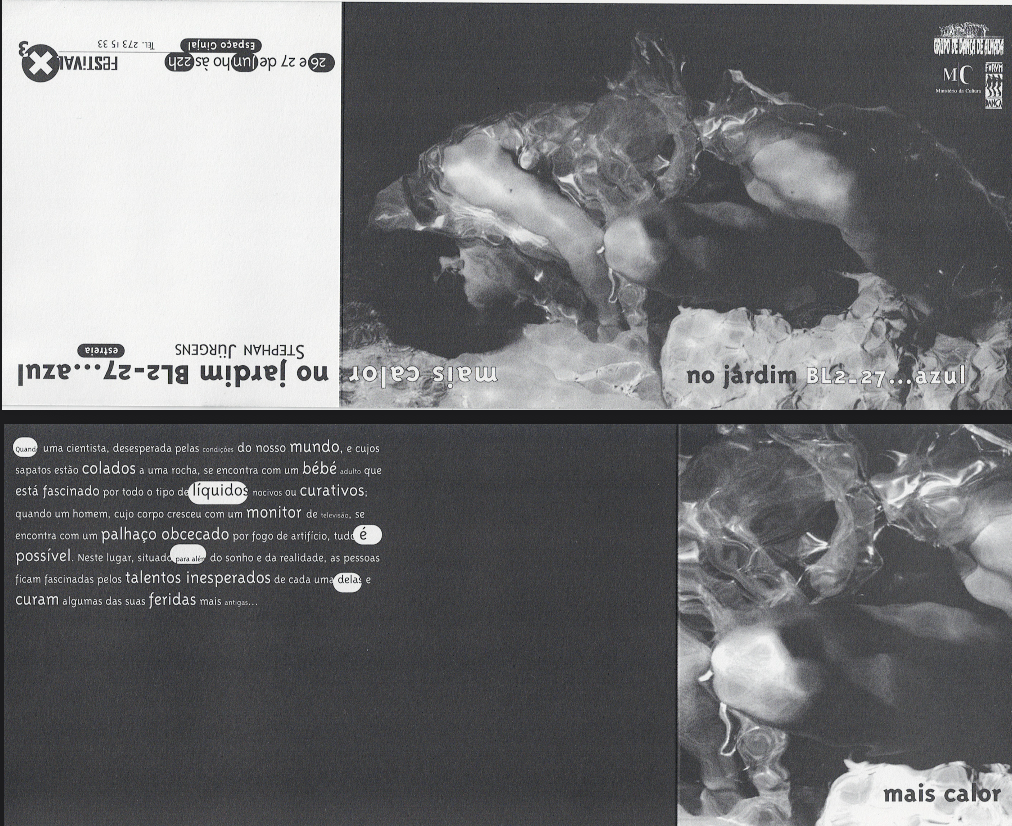
mais calor no jardim BL2-27…azul (1997)
mais calor no jardim BL2-27…azul (1997)
Concept and choreography Stephan Jürgens
Festival X3, Espaço Ginjal, Cacilhas, 26–27 June 1997
Developed from joseph b. (Culturgest, 1996), this piece grew out of a two-year study of the work of Joseph Beuys and of his understanding of society as a "social sculpture" to be improved through socially oriented creativity. Human warmth appears as a catalyst for change: "more warmth" between people happens when a concrete situation leads one person to be moved by another, and to change their life through that encounter. Video, original music and stage design were integral to the piece, which was supported by the Portuguese Ministry of Culture and co-produced by Grupo de Dança de Almada.
Credits: concept and choreography Stephan Jürgens; original music Claire Honigsbaum; video Marcos Filipe; lighting design José Rui Silva; set design Eric da Costa; costumes Cristina Basto; photography Isabel Afonso; performers Cláudia Dias, Filipa Antunes, M. João Garcia, M. José Bernardino and Stephan Jürgens; graphic design Jaime Ribeiro; production Maria Franco. Support Ministério da Cultura and Forum Dança; co-production Grupo de Dança de Almada.